SCIENCE BRINGS NATIONS TOGETHER
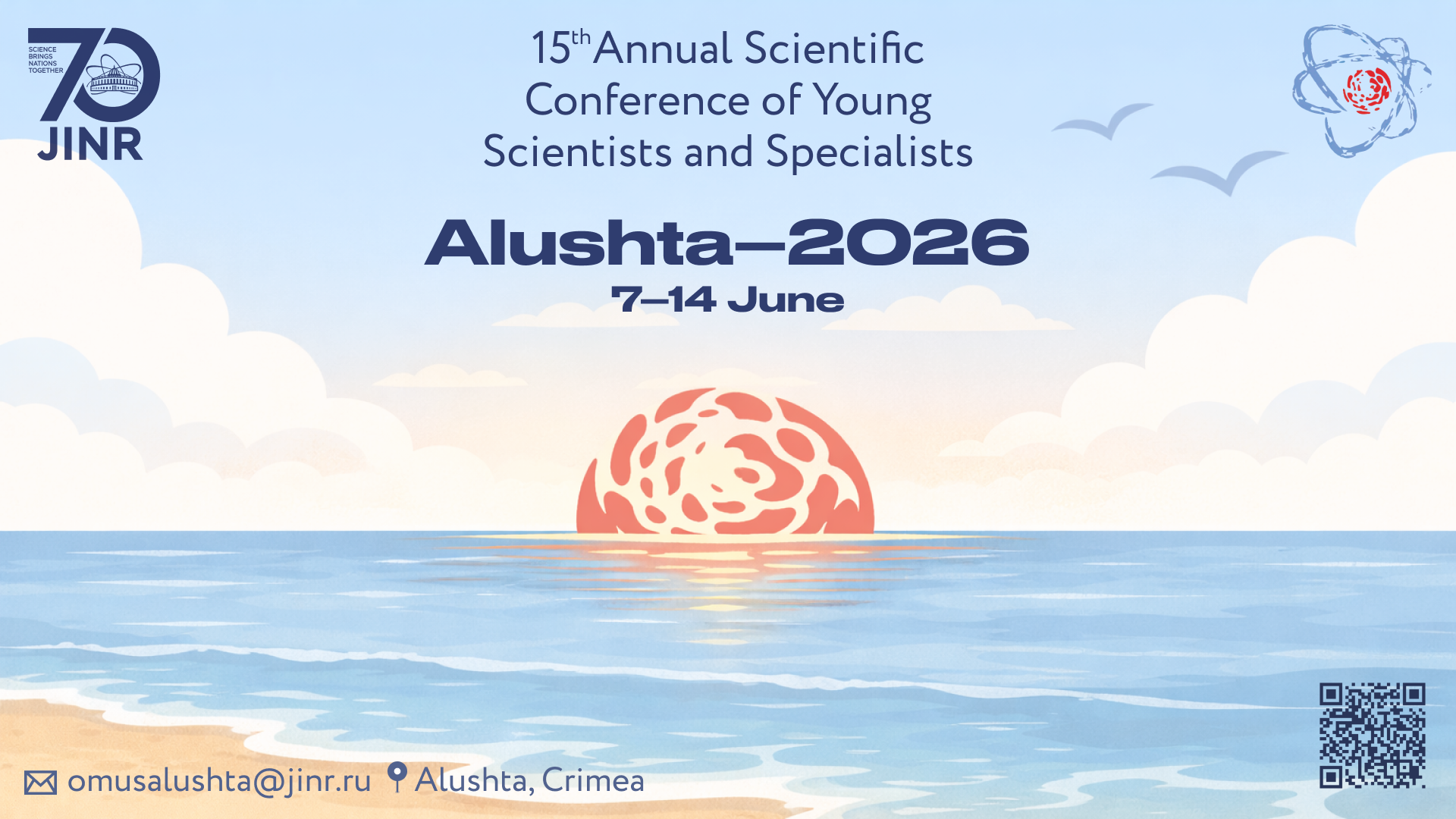
JINR Association of Young Scientists and Specialists Conference "Alushta-2026"

→ Europe/Moscow
Description

The Association of Young Scientists and Specialists (AYSS) of the Joint Institute for Nuclear Research (JINR) welcomes you to the 15th Scientific Conference of Young Scientists and Specialists, Alushta-2026, which will take place from 7 to 14 June 2026.

This year, JINR celebrates its 70th anniversary, a milestone marking seven decades of outstanding achievements in nuclear physics and related fields. In this context, the Alushta-2026 conference will focus on the Institute’s key scientific results, major infrastructure projects, and future plans.

The conference will provide a platform for young researchers to present their scientific results, exchange ideas, and discuss promising directions for the development of science. The programme will include lectures by leading scientists of JINR and sectional talks. In addition, a round table with the JINR Directorate will be held, offering participants the opportunity to discuss key issues related to scientific infrastructure, research processes, and social policy at the Institute.

PARTICIPANTS:
Undergraduate students, PhD students, young scientists and specialists under 36 are invited to give talks. Participants will be selected by the Programme Committee based on submitted applications.

WORKING LANGUAGES:
English and Russian (English is preferred). Please note that presentation slides must be in English.

PRESENTATION FORMAT:
The duration of each talk is 10 minutes, including 7 minutes for the presentation and 3 minutes for questions and discussion.

BEST TALK COMPETITION:
A competition for the best talk will be held in each scientific section. The winners will be selected by the Programme Committee based on the quality of research as well as clarity of presentation and answers to the questions, and will be awarded at the closing ceremony.

The best presenters will be selected to enter the second stage of the JINR AYSS Prize competition.

REGISTRATION FEE:

  • for JINR employees: 18,000 RUB
  • for external participants: 21,960 RUB

The fee includes transfers, accommodation, meals, coffee breaks, a participant gift bag, an excursion, and welcome and farewell dinners.

APPLICATION DEADLINE: 24 April 2026, 23:59 (MSK).

The list of selected participants will be published on the conference website.

For additional information, please contact omusalushta@jinr.ru.
Details about transfer will be provided later.

We look forward to seeing you at Alushta-2026!
Participants
    • 12:00 → 13:00
      Participants Arrival at the Simferopol Railway Station
    • 13:00 → 14:00
      Hotel Chek In
    • 14:00 → 15:00
      Lunch 1h
    • 15:00 → 17:00
      Free Time
    • 17:00 → 18:00
      Registration
    • 18:00 → 19:00
      Dinner 1h
    • 19:00 → 19:30
      Opening ceremony
      • 19:00
        Organizing moments 30m
        Speaker: Регина Кожина (LRB)
    • 19:30 → 20:00
      Plenary talk
      • 19:30
        Про пансионат "Алушта" 30m
        Speaker: Александр Курицин
    • 20:00 → 23:00
      Welcome party
    • 08:00 → 09:00
      Breakfast 1h
    • 09:00 → 10:15
      Plenary talk: LRB
      • 09:00
        LRB 1h 15m
        Speaker: Elena Nasonova
    • 10:15 → 11:15
      Section talk: LRB, FEFU
      • 10:15
        Investigation of the Feasibility of Beam-Based PET Diagnostics in Proton FLASH Therapy 10m

        Proton FLASH therapy (dose rate >40 Gy/s) spares healthy tissue but complicates dose monitoring. This work investigates in‑beam PET for range verification in FLASH proton therapy using GEANT4 simulations. A 200 MeV proton beam was directed into a brain‑equivalent phantom, and the production of ¹⁵O, ¹¹C and ¹³N was simulated. The specific activity in the Bragg peak reaches ~915 kBq/mL for clinical FLASH parameters (6×10¹⁰ protons per session), well above the PET detection threshold (~100 kBq/mL). The FLASH pulse duration (0.1 s) is three orders of magnitude shorter than the biological washout time of ¹⁵O, eliminating signal blurring. Under identical proton fluence, the PET signal is identical for FLASH and conventional irradiation, but FLASH provides a distortion‑free snapshot of the dose distribution. In‑beam PET is thus a promising tool for range verification in FLASH proton therapy.

        Speaker: Darya Mekh
      • 10:25
        Study of the Influence of Magnetic Field Orientation and Magnitude on Dose Distributions in Proton Therapy Using Geant4 Simulations 10m

        The integration of magnetic resonance imaging into proton therapy (MRgPT) offers improved targeting accuracy but introduces dose distortions due to the Lorentz force acting on the proton beam in the MRI magnetic field. This study investigates the influence of magnetic field magnitude and orientation (parallel, perpendicular, and 45°) on the dose distribution of a 200 MeV proton beam in a water phantom using Geant4 Monte Carlo simulations. A voxelized model with 1.0 mm resolution was developed to score three-dimensional dose distributions. Results show that the perpendicular configuration produces the largest lateral Bragg peak displacement and transverse profile asymmetry, while the parallel orientation causes minimal shift but induces beam rotation. The 45° configuration exhibits intermediate effects. All distortions increase with magnetic field strength. The obtained quantitative data can support the validation of dose correction algorithms for MRgPT treatment planning systems.

        Speaker: Daria Prokopenko
      • 10:35
        Effect of the DNA-dependent protein kinase inhibitor NU7026 on the radiosensitivity of B16 mouse melanoma cells 10m

        Double-strand breaks (DR) are among the most difficult for DNA damage repair systems, as they require the repair of both DNA strands at once. Incorrect repair of DR DNA in normal cells can lead to chromosomal rearrangements and activation of cell death processes. One of the main ways of DNA repair is through non-homologous end joining, where DNA-dependent protein kinase (DNA-PK), representing a protein complex, is activated in the first seconds after its occurrence. DNA-PK consists of the regulatory subunit Ku70/80 and the catalytic subunit DNA protein kinase (DNA-PKSs). In response to the formation of DR DNA, the DNA-PK complex assembles and phosphorylates a number of DR DNA repair proteins, one of which is histone H2AX (yH2AX), which signals the presence of a gap and ensures the involvement of other repair proteins such as 53BP1. 53BP1 helps stabilize the free ends of DR DNA and restricts the access of proteins of other repair pathways. The yH2AX and 53BP1 proteins, which form radiation-induced foci, are classic markers for active DNA repair processes. Successful completion of DR DNA repair is accompanied by the disappearance of yH2AX and 53BP1 foci, or activation of cell death. In tumor cells, unlike normal ones, even incorrect repair of DR DNA is not an obstacle to the initiation of cell division, which is one of the reasons for their high radioresistance. The use of DNA repair inhibitors that block the correct repair of DNA in tumor cells after irradiation can enhance the effect of the latter.
        In this study, the combined effect of X-ray radiation and an inhibitor of the catalytic subunit of DNA protein kinase, NU7026, on murine melanoma B16 cells was studied. Analysis of the cytotoxicity of NU7026 showed that in the concentration range from 5 to 20 microns, the viability of B16 cells decreases slightly, indicating a low cytotoxicity of the inhibitor. At a concentration of 20 microns, the survival rate decreases by 28% compared to the control without the inhibitor. When exposed to X-ray radiation (2 Gy) under the influence of NU7026 (20 microns), a 47% decrease in the viability of melanoma cells is observed.
        The method of colony formation revealed a dose-dependent decrease in the survival of B16 cells, described by sigmoid dependence. The survival rate of B16 cells under the action of X-ray irradiation in combination with NU7026 enhanced the radiosensitizing effect of irradiation - the dose change factor at 10% survival (<₁₀%) was 1.33± 0.28. Analysis of the combined effect revealed a significant synergistic effect: the coefficient of synergy ranged from 0.50 ± 0.09 to 0.21 ± 0.01 at doses from 1 to 5 Gy.
        The effect of the NU7026 inhibitor on the kinetics of formation and elimination of radiation-induced yH2AX and 53BP1 foci (RIFs) in the nuclei of B16 cells under the action of X-ray radiation at a dose of 1.25 Gy was studied. It was found that the maximum number of foci is formed 1 hour after irradiation, followed by a decrease to control values by 24 hours of radiation incubation. Under the influence of the inhibitor, there was a significant increase in the number of RIFs by 1.4 and 1.3 times after 6 hours (P<0.001) and 24 hours (P=0.003) after irradiation, respectively, in comparison with the irradiated control, which indicates a decrease in the ability to repair DR DNA.
        A similar decrease in the efficiency of DR DNA repair was observed for the 53BP1 marker: the elimination of foci was reduced by 1.4 times after 4 hours and 2.0 times after 6 and 24 hours after irradiation (P<0.001). The reliability analysis was performed using the nonparametric Kruskal-Wallis test.
        The persistence of yH2AX and 53BP1 foci up to 24 hours of radiation incubation in the presence of an inhibitor indicates ineffective repair of double-stranded DNA breaks, which leads to increased cell death and increased cell radiosensitization.

        Speaker: Александра Ясинская
      • 10:45
        Анализ хромосомных аберраций в лимфоцитах периферической крови человека, индуцированных разными типами ионизирующих излучений 10m

        В работе изучали образования хромосомных аберраций в лимфоцитах переферической крови человека после облучения γ-60Co, рентгеновским излучением (220кВ) и ускоренными ионами азота 14N (Е=46МэВ/н, ЛПЭ 70кэВ/мкм). Для анализа хромосомных аберраций использовали стандартный метафазный метод, который является наиболее информативным способом оценки хромосомных нарушений в радиационной цитогенетике. Основной целью работы является изучение дозовой зависимости частоты хромосомных аберраций в лимфоцитах при действии ионизирующего излучения разного качества in vitro. Сравнивали образование разных видов нестабильных аберраций хромосом при действии ионизирующих излучений. Оценивали относительную биологическую эффективность (ОБЭ) ускоренных ионов азота 14N на равных уровнях эффектов с использованием двух видов стандартного излучения. Величина ОБЭ ионов азота 14N в сравнении с γ-излучением на уровне одной аберраций на клетку составила 4.8, а в сравнении с рентгеновским излучением- 4,2.

        Speaker: Ару Нуркасова (ОИЯИ)
      • 10:55
        CHROMOSOMAL INSTABILITY IN CHINESE HAMSTER CELLS MUTANT IN THE HPRT GENE AFTER IRRADIATION WITH ⁶⁰CO γ-RAYS AND ¹¹B IONS 10m

        A cytogenetic analysis of HPRT-mutant subclones isolated at different time points after irradiation with ⁶⁰Co γ-rays and accelerated ¹¹B ions was performed. The manifestations of chromosomal instability depend on the type of radiation studied.
        Among HPRT-mutant subclones obtained after ⁶⁰Co γ-rays irradiation at all time points of the study, samples were identified with chromosomal aberration levels that did not differ from control, along with samples exhibiting elevated aberration frequencies and those showing extremely high levels of chromosomal abnormalities. In early time points, a dose-dependent decrease in the proportion of mutants with control-like aberration levels was observed: 0.5 Gy - 50%, 1 Gy - 43.8%, 2 Gy - 26.3%. No clear patterns in group distribution were detected among HPRT-mutant subclones obtained at later time points.
        Following irradiation with accelerated ¹¹B ions, HPRT-mutant subclones isolated at early time points consistently exhibited elevated and extremely high levels of chromosomal aberrations. In contrast, subclones obtained at later time points included mutants with aberration frequencies indistinguishable from the control. Notably, their proportion increased with dose: 0.5 Gy - 11.8%, 1 Gy - 35.7%, 2 Gy - 80%. Furthermore, some mutants displayed aberration levels even below control values, with frequencies of 7% at 1 Gy and 30% at 2 Gy.
        The obtained data indicate the emergence and maintenance of chromosomal instability in the population of irradiated cells. Mutant subclones isolated after exposure ⁶⁰Co γ-rays are characterized, irrespective of the observation time and irradiation dose, by heterogeneity in the yield of cells with chromosomal aberrations. Mutant subclones isolated after exposure to dense, highly ionizing boron ions ¹¹B exhibited the presence of a reverse dose–response relationship for the yield of chromosomal aberrations across all observation periods. At the extended observation times, the level of cells with chromosomal aberrations at a dose of 2 Gy decreases and approaches the spontaneous level values. In the extended periods after exposure to heavy boron ions ¹¹B, we observed a dose-dependent decrease in chromosomal instability.

        Speaker: Irina Smekina
      • 11:05
        Analysis of chromosomal damage in blood lymphocytes of Macaca mulatta monkeys after ɣ-irradiation and local irradiation of the dorsolateral prefrontal cortex of the animal brain with carbon ions. 10m

        The attention of many researchers is directed to the assessment of risks and dangers associated with the effects of cosmic radiation on crew members during long space missions outside Earth's magnetosphere. Before planning missions, it is important to assess the possible risks and identify the radiobiological markers of cytogenetic damage caused by various types of ionizing radiation that will be encountered during flights. Monkeys serve as the most relevant model for predicting the human body’s response to the extreme conditions of manned space expeditions.
        The paper presents data on chromosomal abnormalities in blood lymphocytes of Macaca Mulatta monkeys after total exposure to 137Cs γ-rays under hypokinesia and local irradiation of the dorsolateral area of the animals' heads with accelerated 12C ions at a dose of 1 Gy with an interval of 2 days. The studies were carried out 2, 26, 46, 102 and 466 days after carbon ion irradiation.
        The cytogenetic analysis of chromosomal aberrations showed that the maximum yield of chromosomal abnormalities was observed two days after the combined effects of hypokinesia, γ-ray irradiation, and accelerated 12C ions on the heads of Macaca mulatta monkeys, and it was 8.57 %. At 466 days post‑irradiation, the number of cells with chromosomal aberrations decreased five‑fold but still remained 1.5 times higher than the control values.
        The study of chromosomal abnormalities observed in the blood lymphocytes of Macaca mulatta monkeys after exposure to simulated microgravity and ionizing radiation contributes to a deeper understanding of the combined effects of weightlessness and heavy charged particles, which are characteristic of the conditions of manned interplanetary flights. These findings are important for assessing the long-term risks of genetic damage in astronauts and developing effective radiation protection strategies.
        Therefore, this study highlights the significance of monitoring and evaluating the consequences of radiation exposure both in the early and long-term periods after exposure.

        Speaker: Maria Isakova
    • 11:15 → 11:30
      Coffee-break 15m
    • 11:30 → 11:45
      Group photo 15m
    • 11:45 → 13:30
      Plenary talk: DLNP
      • 11:45
        Физика нейтрино в ОИЯИ 1h 45m
        Speaker: Liudmila Kolupaeva (JINR)
    • 13:30 → 14:20
      Section talk: DLNP, FEFU
      • 13:30
        Influence of Chemically Etched Reflective Layer Thickness of Scintillator Strips on Light Collection 10m

        This work aims to determine the optimal chemical-etching time required to produce an efficient reflective surface on scintillator strips. To achieve this goal, we investigated the light collection efficiency, optical transparency, and reflectivity of strips with different reflective-layer thicknesses formed through controlled chemical etching. Light collection measurements were performed at a fixed distance between the trigger counters and the photomultiplier tube for strips with systematically varied reflective-surface thicknesses. Systems assembled from such strips are used in high-energy physics experiments to detect charged particles. In particular, in the Mu2e and COMET experiments, events caused by cosmic rays and registered by such systems are excluded from further data analysis.

        Speaker: Озода Иноятилло (Joint Institute for Nuclear Research)
      • 13:40
        software development for the system micro-SPECT based on a coding aperture and a Timepix semiconductor detector 10m

        Odating apertures make it possible to increase the efficiency of gamma ray detection in microfect
        systems without mechanical scanning, however, reconstruction of volumetric distributions of sources
        is complicated by overlapping projections and the appearance of intersectional artifacts (false traces).
        The work developed and tested a three-dimensional reconstruction method for a prototype system
        based on a Timepix pixel detector and a MURA mask of the 31st rank. Two approaches to
        decoding shadowgrams are proposed: an algorithm for pixel-by-pixel geometric matching with synthesized ones.
        auxiliary shadows (accelerated by pre-calculating bin files) and the architecture
        of a convolutional neural network. Modeling of the detector system and generation of training samples
        are performed in Geant4. The effect of the slice position relative to the focal plane
        on the resolution (FWHM ∼1.25–2.8 mm) is analyzed and a method for suppressing false traces using
        paired projections when the object is rotated 180 degrees is proposed.
        Experiments have shown that the pixel-by-pixel algorithm provides high geometric
        accuracy and reduces the reconstruction time to 20 seconds per layer, and the neural network model is successful.
        restores the boundaries of the sources, but requires the expansion of the training dataset to reliably
        separate closely spaced layers (<1 cm). The results lay the foundation for fast
        three-dimensional visualization of radiopharmaceutical distributions using compact
        coding apertures.
        Keywords: Microfect, coding aperture, Timepix, image reconstruction,
        MURA, Geant4, neural networks, tomography.

        Speaker: Никита Терновой (FEFU)
      • 13:50
        Micromegas detector test results at the PS/T9 beamline at CERN 10m

        This report presents the development and testing results of two Micromegas prototype detectors designed for the SPD experiment, conducted at the CERN PS/T9 beamline. The study focuses on optimizing detector performance by evaluating the impact of pillar geometry, strip pitch, and the resistance of the protective DLC (Diamond-Like Carbon) layer using multi-channel electronics. Experimental results demonstrate an intrinsic detection efficiency of approximately 99% and a spatial resolution of about 80 µm. A comparative analysis was performed to assess the influence of design parameters—specifically two strip pitch options and two distinct DLC surface resistance values—on noise levels and cluster size. These findings are instrumental in determining the optimal detector configuration for the final assembly of the SPD tracker.

        Speaker: Igor Liashko
      • 14:00
        Study of correlations of secondary charged particles in hadron-hadron collisions 10m

        Study of secondary charged particle correlations in hadron-hadron collisions to evaluate the feasibility of reconstructing hard process kinematics at NICA collider energies.

        Speaker: Mr Серафим Серюбин (JINR)
      • 14:10
        Development of control software and a micro-SPECT/CT synchronization subsystem 10m

        This work is devoted to the development of software for controlling a micro-SPECT/CT microtomography system, implemented at the Laboratory of Nuclear Problems (DLNP) of JINR under the scientific supervision of V. A. Rozhkov. The relevance of the study is determined by the need to adhere to the 3R principle (Reduction, Refinement, Replacement), aimed at reducing the number of laboratory animals, as well as the limitations of commercial systems with closed architectures and complex equipment synchronization.
        The goal of the work was to create flexible, open-source software based on Python (PyQt5, libximc, Pypixet) that ensures high-precision positioning and synchronization of the Standa mechanical axes with the Timepix semiconductor detector. This study included the development of a modular multithreaded architecture, the implementation of rotational and linear axes calibration algorithms, and scanning protocols with automatic parameter calculation. Particular attention was paid to software synchronization of the event-driven detector with sample movement. Experimental validation confirmed the solution's effectiveness: no positioning errors or mechanical transmission backlash were detected, and high movement repeatability was achieved. A long-term performance test (1.5 hours of continuous scanning) demonstrated the system's stability without interface freezes or communication failures. The developed software saves configurations in JSON format, ensuring the reproducibility of experiments.

        Speaker: Nikita Karpov (men)
    • 14:20 → 15:20
      Lunch
    • 15:20 → 18:00
      Free Time
    • 18:00 → 19:00
      Dinner
    • 19:00 → 23:00
      Sport 4h
    • 08:00 → 09:00
      Breakfast 1h
    • 09:00 → 10:15
      Plenary talk: MLIT
    • 10:15 → 11:25
      Section talk: MLIT
      • 10:15
        SPD Computing Infrastructure and Data Production 10m

        Preparations for the SPD experiment at the NICA collider are underway. While the detector is being built, large-scale Monte Carlo simulations and data reconstructions are already being performed. The process of obtaining data ready for final analysis is a complex multi-stage processing, at each step of which intermediate data is generated. A special infrastructure has been created to organize the complete production chain, as well as the processing and storage of these large amounts of data. This report describes the current status of the SPD Computing System, and data generation process. It explains the data production process, how production tasks are organized, and how the system coordinates the production process.

        Speaker: Alexey Konak (JINR)
      • 10:25
        Prototyping the SPD Online Filter as a Private Cloud Infrastructure: Towards a Dynamical System Formulation 10m

        The SPD Online Filter is an essential intermediate system between the continuous data stream from the free-running DAQ and the distributed offline data processing system for the SPD experiment at NICA. Acting as a sophisticated software trigger, the Online Filter must handle high data rates, necessitating a highly scalable and resilient online filtering middleware. We present an Infrastructure as Code (IaC) pipeline for the automated provisioning, configuration management, and orchestration of a private cloud infrastructure. Beyond practical deployment, a reproducible infrastructure provides a key foundation for studying the system’s complex dynamics. Finally, we describe how the private cloud can serve as a flexible testbed, enabling multifactorial debugging of both middleware and application software within the SPD Online Filter.

        Speaker: Nikita Greben (JINR MLIT)
      • 10:35
        Data Flow and Data Control in the SPD Online Filter Middleware 10m

        The Spin Physics Detector (SPD) is being constructed as a part of the NICA mega-scientific project at the Joint Institute for Nuclear Research. It is expected that the data flow from the detector may reach up to 200 PB per year due to the absence of a hardware trigger. To reduce the volume of data for long-term storage and subsequent analysis, the primary processing will be performed by a specialized computing system - SPD Online Filter.

        This report describes the design and integration of two components developed for the SPD Online Filter: the DAQ Emulator Service and the Data Management System (DMS). The DAQ Emulator is responsible for data flow modeling. The recorded data primarily ends up in the DMS, which is responsible for managing the lifecycle of experimental data.

        Speaker: Polina Korshunova (JINR MLIT)
      • 10:45
        From a Static Pipeline to a Self-Managing One: A Workflow Management System for the SPD Online Filter 10m

        The SPD experiment at the NICA collider produces enormous data streams that cannot be stored as-is. Before anything reaches long-term storage, the SPD Online Filter reduces this flow through a chain of automatic processing stages. Coordinating that chain — deciding which step runs next, where its results are placed, and what can be safely discarded — is the job of the Workflow Management System (WfMS). This talk presents the WfMS developed for the SPD Online Filter. The system does not blindly follow a predefined pipeline: it reacts to its own environment — taking into account how full the data storage is, how long each task has been waiting, and the role the task plays in the processing chain — and uses this information to decide what to run next. It also cleans up after itself — removing unused intermediate data automatically and handling failures gracefully — which makes the pipeline more stable and reduces routine manual work for operators. The result is a system that manages itself, better prepared for the sustained data rates expected from the SPD Online Filter.

        Speaker: Леонид Романычев
      • 10:55
        SPD Production control panel 10m

        The SPD (Spin Physics Detector) is currently being built as part of the NICA complex at JINR. Simultaneously with detector construction, the experiment’s software ecosystem is being developed to support large-scale simulation of physical processes.

        According to the Technical Design Report, the collaboration expects high luminosity, which will result in substantial data volumes. To support such a workload at scale, we have developed a specialized system that automates routine operations and consolidates all actions required to configure both individual tasks and task chains in a single interface.

        The system is already operational and has helped physics working groups launch dozens of tasks to simulate millions of events. This talk presents the design and implementation of the production control panel system.

        Speaker: Nikita Monakov
      • 11:05
        Gravitino pair production at the LHC 10m

        The report presents the results of a study of the processes of paired gravitino production at the Large Hadron Collider (LHC). The observability of such processes under LHC conditions is assessed. In the model under study, the gravitino is the LSP and is also considered a candidate for a dark matter particle.

        Speaker: Sofia Frank-Kamenetskaya
      • 11:15
        Development of additive technologies and 3D modeling at MLIT JINR 10m

        The report discusses the main stages of the creation and development of the MLIT JINR additive technologies and 3D modeling laboratory. Special attention is paid to the integration of high-tech equipment into the institute's infrastructure to solve engineering problems. The report describes the experience of using various 3D modeling methods to create modified power supply systems that ensure the operation of MICC JINR IT equipment. The article describes the main stages of the additive technologies and 3D modeling laboratory development, 3D modeling methods, and the prospects for scaling up within the framework of MLIT JINR development.

        Speaker: Andrey Evlanov
    • 11:25 → 11:45
      Coffee-break 20m
    • 11:45 → 13:00
      Plenary talk: BLTP
    • 13:00 → 13:20
      Section talk: BLTP & Offices and Departments
      • 13:00
        Absolute Mass Probes in the 3+2 Sterile Neutrino Scenario 10m

        The three-flavor neutrino oscillation framework explains most experiments but faces anomalies suggesting additional sterile states: eV-scale from LSND/MiniBooNE and sub-eV from T2K–NOνA tension/solar upturn absence. These Standard Model singlets mix via active neutrinos. We study 3+2 phenomenology (one eV-scale + one sub-eV sterile), its effects on absolute-mass observables (cosmological sum, beta-decay effective mass, 0νββ Majorana mass), and find it alters allowed parameter space vs. 3ν/3+1 cases - disfavoring some mass orderings per current limits. Upcoming KATRIN/Project 8/nEXO sensitivities will probe this via complementary sub-eV roles beyond 3ν.

        Speaker: Rajeev N (BLTP, JINR)
      • 13:10
        Развитие цифровой системы авансовых отчетов в ОИЯИ: от электронной очереди к комплексной среде их формирования и предварительной проверки 10m

        Эффективность научной деятельности во многом зависит от качества организации административных процессов. Бухгалтерией ОИЯИ совместно с ЛИТ ведется активная работа по цифровой трансформации системы авансовых отчетов о командировании avans.jinr.ru с целью сокращения времени ожидания записи (сейчас около 3-х недель) и продолжительности сдачи авансового отчета (на сегодня от 10 до 50 минут), а также повышения прозрачности учетных операций в Институте.
        В докладе представлены ключевые нововведения системы, центральным из которых является создание среды для дистанционного формирования и предварительной удаленной проверки авансового отчета бухгалтерией. Внедряемые функциональные возможности включают удаленную загрузку копий или электронных оригиналов подтверждающих документов, систему контекстных подсказок для различных типов расходов и возможность формирования электронного архива, упрощающего прохождение Институтом аудиторских проверок.
        Ожидаемый результат – устранение очереди на сдачу отчетов, уменьшение числа ошибок при формировании документов и сокращение временных затрат сотрудников ОИЯИ на административные процедуры в пользу решения приоритетных исследовательских задач Института.

        Speaker: Lubov Shiryaeva
    • 13:20 → 13:40
      Plenary talk: JINR Gallery
    • 13:40 → 14:40
      Lunch
    • 14:40 → 15:40
      Plenary talk
      • 14:40
        Volga resort hotel 1h
        Speaker: Andrey Tamonov (USI JINR)
    • 15:40 → 16:40
      Discussion 1h
    • 16:40 → 18:00
      Plenary talk: MEPhi
      • 16:40
        Birth of Elements 1h 20m
        Speaker: Egor Zadeba
    • 18:00 → 19:00
      Dinner
    • 19:00 → 21:20
      Movie 2h 20m
    • 08:00 → 09:00
      Breakfast 1h
    • 09:00 → 10:15
      Plenary talk: FLNP
      • 09:00
        Фундаментальные исследования с нейтронами. Роль лаборатории нейтронной физики им. И.М. Франка в мировой науке. 1h 15m
        Speaker: Maxim Zakharov (MIPT, FLNP)
    • 10:15 → 11:05
      Section talk: FLNP
      • 10:15
        Neutron diffraction study of the effect of melt cooling rate on the initial phase composition of the Fe75Ga12.5Ge12.5 alloy and its evolution during continuous heating 10m

        The study of phase transformations in iron-based alloys is a key area of ​​materials science. Over the past several decades, iron alloys containing nonmagnetic elements such as Ga, Al, and Ge have attracted particular interest. This is because the introduction of these elements into iron significantly alters the magnetostrictive properties of the alloys, making them promising for practical applications [1].
        Structural and materials science studies often utilize binary and ternary alloys obtained in different initial states, the phase composition of which depends primarily on the cooling rate. Understanding the influence of production conditions on the initial phase composition of the above-mentioned alloys, as well as identifying differences in the order of phase transformations, will not only clarify the fundamental principles of structure formation in them but also enable the control of their functional and performance properties.
        This study investigated the evolution of the phase composition of the cast Fe75Ga12.5Ge12.5 alloy, which was obtained by two methods. Alloy A was cast in a copper mold measuring 4 x 16 x 60 mm³, which facilitated rapid cooling of the ingot. Alloy B was cast in a cast iron mold measuring 35 x 100 mm³, which resulted in slower cooling.
        In situ neutron diffraction measurements were performed using a high-resolution Fourier transform diffractometer (HDF) and an IBR-2 diffractometer (JINR, Russia) and a General Purpose Powder Diffractometer (GPPD) (CSNS, China). The alloys were studied by continuously heating to 850°C (alloy A) and 1000°C (alloy B) at a rate of 2°C/min and subsequent cooling. It is known that during rapid crystallization from the melt, a nonequilibrium phase D03 is formed in the binary alloy Fe75Ga25 [2], and a mixture of D019 and B82 [3] in Fe75Ge25. As a result of the experiment, it was found that in the alloy Fe75Ga12.5Ge12.5, at a higher cooling rate of the ingot (alloy A), a single-phase state is formed, represented by an ordered D03 phase. With slower cooling (alloy B), two polymorphic modifications of Fe3(Ga,Ge) are formed with ordering by the D03 and D019 types. In the case when the initial phase composition of the alloy is represented by the D03 phase (alloy A), the D019 phase is separated at a temperature of 710 ± 15 ℃. If the initial phase composition contains two polymorphic modifications of Fe3(Ga, Ge): with ordering of the D03 and D019 types, then at the same temperature an increase in the volume fraction of the D019 phase is observed. The Curie temperatures of individual phases upon heating were: Tc (D03) ≈ 500℃ ± 15 ℃, Tc (D019) ≈ 550℃ ± 15 ℃. Thus, regardless of the initial phase composition, both studied Fe75Ga12.5Ge12.5 A and B alloys demonstrate a similar order of phase transformations.

        The work was carried out under project No. 26-13-00152 of the Russian Science Foundation

        Speaker: Ms Anna Zakharova
      • 10:25
        A beryllium reflector: the reasons for such a significant gain in the thermal neutron flux from the surface of a water moderator. 10m

        In this work, the gain in directed flux density from the surface of a water moderator when using a beryllium reflector will be presented, the shape and width of the neutron pulse will be shown, and the reasons for such a significant gain compared to the absence of a reflector around the water moderator will be explained.

        Speaker: Maxim Podlesnyy (FLNP JINR)
      • 10:35
        An investigation into the use of a beryllium neutron reflector encircling compact fast research reactors 10m

        The Frank Laboratory of Neutron Physics (FLNP) is currently developing a new pulsed high‑flux nuclear reactor to succeed the IBR‑2M reactor upon completion of its operational lifetime. Among the proposed designs, the NEPTUNE reactor stands out as a promising candidate. It will feature an average power of 12–15 MW, a pulse duration of 210 μs, an average neutron flux of 1.6×10¹⁴ n/cm²/s, and a peak neutron flux of 3.8×10¹⁷ n/cm²/s. Notably, NEPTUNE will be the first reactor to employ fuel based on the Np‑237 isotope.

        Another major difference between the IBR‑2M and the NEPTUNE proposal, besides the pioneering use of Np‑237‑based fuel, is the planned implementation of a stationary neutron reflector made of beryllium (Be) in the NEPTUNE reactor. The use of a beryllium (Be) neutron reflector offers several key advantages, including a reduction in the critical mass and an increase in the thermal neutron flux.

        In addition to these advantages, a key anticipated side effect is the elongation of the thermal neutron flux pulse, particularly when beryllium (Be) is used in conjunction with a water moderator. This effect arises due to the combined moderation and reflection properties of the materials.

        The report and presentation will detail a computational investigation into the influence of beryllium reflector thickness — when placed around the reactor core — on key neutronic parameters, including neutron flux distribution, criticality, and reactivity.

        Speaker: Dr Ахмед Хассан (ОИЯИ - ЛНФ)
      • 10:45
        Transitions between energy levels during the storage of ultracold neutrons in a gravitational-magnetic trap. 10m

        The report is devoted to the results of a theoretical numerical study of non-stationary quantum effects arising during the storage of ultracold neutrons in a gravitational field above a Vladimirskiy magnetic mirror due to the presence of an external periodic perturbation acting on the quantum system. In such a system, the energy corresponding to the vertical motion of neutrons takes discrete values – energy levels. The presence of an external perturbation induces transitions of neutrons between energy levels. The study was carried out by solving the non-stationary Schrödinger equation within the framework of time-dependent perturbation theory. As a result of the calculations, the time evolution of the wave function was obtained. It was shown that the neutron transitions between energy levels exhibit a resonant character depending on the frequency of the external perturbation.

        Speaker: Valeria Vasileva
      • 10:55
        Electrical impedance analysis of a ZrO2-based nanopowder system under ionization conditions 10m

        One of the growing areas of interest in nanotechnology is gas monitoring, where the precise measurement of physical and chemical parameters is essential to optimize industrial and environmental processes. This is why Yttria-stabilized zirconia (YSZ) nanopowder systems are promising materials for gas monitoring applications, particularly in high-humidity environments, where the surface layer of adsorbed water plays a fundamental role in the detection mechanism.
        Previous studies have shown that ZrO₂, especially in its yttrium-stabilized form (YSZ), exhibits high ionic conductivity and excellent thermal stability, making it suitable for electrochemical devices such as sensors
        This work introduces and evaluates the effect of an external factor, ionizing irradiation, as a means to modify the surface microstructure and defect density of YSZ in a controlled manner, potentially altering the water adsorption affinity, surface ion mobility, and consequently the electrical response of the electrochemical double layer. Electrochemical Impedance Spectroscopy (EIS) is used as the main technique to characterize irradiation-induced changes in charge transport mechanisms and interfacial capacitance.
        The appearance of a radiation-induced relaxation process accompanied by a decrease in the reactivity of the nanoparticle surface has been established.

        Speaker: Антони Карлос Перес Морено (ЛНФ)
    • 11:05 → 11:25
      Coffee-break 20m
    • 11:25 → 13:00
      Plenary talk: Astrophisic
      • 11:25
        Astrophysics 1h 35m
        Speaker: Sergey Nazarov
    • 13:00 → 14:00
      Lunch 1h
    • 14:00 → 14:50
      Plenary talk: Interaction between AYSS and the Mir Cultural Center
      • 14:00
        The role of art and culture in shaping scientific thinking: an interdisciplinary approach. Mir Cultural Centre – openness, innovation, integration of science and art 50m
        Speaker: Elena Troyan
    • 14:50 → 18:00
      Free Time
    • 18:00 → 19:00
      Dinner
    • 19:00 → 21:00
      Sport 2h
    • 08:00 → 09:00
      Breakfast 1h
    • 09:00 → 10:30
      Plenary talk: VBLHEP
      • 09:00
        NICA - Universe in the Laboratory 1h 30m
        Speaker: Dr Михаил Шандов (Joint Institute for Nuclear Research, Veksler and Baldin Laboratory of High Energy Physics)
    • 10:30 → 11:30
      Section talk: VBLHEP
      • 10:30
        Time-of-Flight Corrections for the TOF-400 Detector in the BM@N Experiment in Run-9 10m

        In 2026, as part of the BM@N experiment at the NICA accelerator complex, experimental data were collected using a xenon beam at energies of 1.6, 2.2, and 3.0 GeV/nucleon. During the recent run, the acceptance of the TOF-400 time-of-flight detector was significantly expanded by adding new modules, necessitating the development of refined calibration and signal correction procedures.

        This work presents a step-by-step algorithm for correcting the experimental data. The proposed approach includes the following stages: verification of the electronics channel map, identification of non-operational channels, left-right ambiguity calibration, correction for differential signal delays in the cable system and the introduction of slewing corrections.

        Comparative results of time-of-flight analysis before and after applying the described corrections are presented. It is shown that the proposed algorithm significantly improves the time resolution of the detector and enhances the reliability of particle identification under conditions of increased acceptance.

        Speaker: Екатерина Хабарова
      • 10:40
        Automated Calibration System for PXIe Modules 10m

        The production of superconducting magnets at the Scientific and Experimental Department of Superconducting Magnets and Technologies (SED SMT) demands high metrological precision. To ensure efficient maintenance, the Magnetic Measurements Group has developed an autonomous calibration system. This setup eliminates reliance on external service centers and provides rapid, in-house verification for the department's extensive fleet of PXIe-based instruments.

        Speaker: Николай Галкин
      • 10:50
        Automated detection of anomalies in the magnetic measurement system during series production testing of superconducting magnets. 10m

        This paper presents an algorithm and a concept for automated monitoring of data acquired during series operations at the magnetic measurement sites of the superconducting magnet assembly and test facility. The system performs continuous real-time analysis of measured signals, [providing enhanced data reliability, minimizing human error, and ensuring the structural integrity of the equipment]. Upon detection of any anomalies, the algorithm automatically terminates the process and issues a notification to the designated personnel, [thereby preventing potential hardware damage and reducing diagnostic downtime].

        Speaker: Валерий Фердерер
      • 11:00
        Analysis of hypertriton lifetime in the BM@N experiment at NICA 10m

        This work is devoided on analyzing the production of hypertritons in the BM@N experiment at the NICA accelerator complex. A comparative study of the signal distributions in the invariant mass spectra obtained from model and experimental data. The analysis of event selection efficiency based on geometric decay parameters is provided. The main result obtained to date is an estimate of the hypertriton lifetime.

        Speaker: Елизавета Константинова (Николаевна)
      • 11:10
        Project FCalPulse. Simulation of the facility in GEANT and data set on the test beam. 10m

        Future collider experiments will expose forward calorimeters to unprecedented ionization rates, leading to space-charge effects that distort detector pulses and degrade energy measurement. To study these effects, a dedicated testbeam setup has been developed with a Sr‑90 beta source embedded in a calorimeter electrode. This presentation presents a full Geant4 simulation of this setup. The model is first validated by reproducing reference results for 350 GeV electrons. The energy deposition from a 180 GeV test beam is then characterized, both with and without the Sr‑90 source. The source geometry is modeled in detail to accurately reproduce the beta spectrum entering the liquid argon (LAr) gap.

        Speaker: Мунира Манашова
      • 11:20
        Аппаратно-программный комплекс для управления и синхронизации оборудования установки SPI 10m

        Разработано комплексное аппаратно-программное решение для мониторинга и управления системами физической инфраструктуры установки SPI (Источник поляризованных ионов). Решение объединяет управление питанием поляризационных ячеек, управление генераторами сигналов для внутренней технической системы SPI и поляризационных меток, а также мониторинг многодиапазонных источников постоянного тока. Обратная связь реализована с использованием стандартных модулей АЦП/ЦАП на базе микроконтроллеров STM32, а параметры охлаждения и температуры контролируются с помощью программируемого логического контроллера (ПЛК). Представленное решение предоставляет возможности для управления параметрами установки SPI.

        Speaker: Никита Дунин (JINR LHEP)
    • 11:30 → 11:50
      Coffee-break 20m
    • 11:50 → 13:00
      Section talk: VBLHEP
      • 11:50
        Performance results of linear accelerators in latest experiments on Nuclotron-NICA 10m

        In the last accelerator runs linacs had to perform unusual tasks to provide decent particle density for physical experiments. For NICA launch Heavy Ion linac had to operate in a mode of multi-turn injection to provide extra beam intensity in a pair with an electron cooling system to fit bunches in a synchrotron-booster. The article describes how linac was modified to fit such task and which solutions were made by operators and accelerator division in general.

        Speaker: Andrei Martynov (JINR)
      • 12:00
        The template method of extraction of the angular coefficicents. 10m

        The distributions of the particles in collider experiments are distorted because of limited detector acceptance, not ideal efficicency of algorithms of track registration, and other detector effects. To measure such a deep effects as Z boson polarization, special procedure is required. The report contains breef description of the template method and how it can be implemented to the Large Hadron Collider data.

        Speaker: Vladislav Shalaev (JINR, Dubna State University)
      • 12:10
        Operation of the RF systems of the NICA accelerator complex during transfers in to the collider. 10m

        In 2025, the first run began at the NICA accelerator complex, where the first heavy ion beams were transferred into the Collider. To implement this transfer, a new LLRF driver systems was commissioned, enabling new operating modes for the injection complex's accelerator systems to the transfer heavy ions between the synchrotrons and the collider.

        Speaker: Alexander Shilin (JINR)
      • 12:20
        Studying the decay of kmu4 in the NA62 experiment 10m

        This work is devoted to the analysis of data from the NA62 experiment, the main task of which is to study the ultra-rare decay $K^{+}→π^{+}ννˉ$. The purpose of the experiment is to obtain results with an accuracy of the order of 10%, which will confirm or refute some aspects of the Standard Model [1].
        ?A large statistics of positive kaon decays has been collected, which makes it possible to study other rare decays, in particular $K^{+}→π^{+}π^{-}μ^{+}ν_{μ}​ (Kμ4​)$. The previous measurement of this mode was performed in 1965 and yielded a branching ratio of (1.4±0.9)×10−5 [2]. In this work, we present еhe analysis strategy, background suppression, normalization procedure, and the first preliminary results are discussed.
        [1] Technical Design Document NA62 Status Report to the CERN SPSC (SPSC- SR071); NA62-10-07, December 2010 // PoS DIS2014. 2014. P. 241.
        [2] D. Cline and W.F.Fry, Phys. Let 3(1965) 293.

        Speaker: Диас Керейбай (JINR)
      • 12:30
        Remote access and synchronization subsystem of electronics cards for the TPC/MPD Detector of the NICA project 10m

        As part of the JINR program of research in high-energy physics research, NICA accelerator complex is currently being developed and will be completed shortly. The Multi-Purpose Detector (MPD) has been designed to investigate the physical processes occurring during heavy ion collisions. The Time-Projection Chamber (TPC) has been chosen as the track detector for the MPD. Located at the center of the MPD superconducting magnet, the TPC is intended for 3D tracking and identification of charged particles. Data acquisition from the TPC will be maintained by 1488 Front-End Cards (FECs) and other modules positioned both inside and outside the MPD magnet.
        One such module is developed, will be used as the remote access and synchronization subsystem for the detector electronics. This module consists of two functional units, both implemented on a single printed circuit board. The first unit is designed to provide remote access to the FPGA (Programmable Integrated Logic Circuit) chips of the DAQ subsystem elements installed on each ROC chamber. The second functional unit is used to synchronize the operation of FECs (installed on ROC) and performs the task of multiplying (fanout buffer) five external sync signals, including a reset signal, data triggers and three types of reference clock frequencies.

        Speaker: Denis Potapov
      • 12:40
        Measures for optimizing accelerating systems to achieve ion circulation in the collider rings, Run №1, NICA complex. 10m

        In 2026, circulating beams of xenon nuclei with an energy of 1.74 GeV/n were achieved in both rings of the NICA collider complex in Dubna. To accomplish this, ion losses were significantly reduced at all stages of acceleration, and the longitudinal bunch size was minimized in the Booster and Nuclotron synchrotrons. A strategy for solving this problem was selected based on the experiments that were conducted and the experience that was gained in previous runs at the injector complex.

        Speaker: Anton Volodin
      • 12:50
        Implementation of the Booster accelerating system operation mode for ion accumulation using electron cooling and RF voltage flattening by adding the second harmonic of the revolution frequency 10m

        Conducting experiments with colliding beams requires higher intensity in the NICA collider. One of the solutions to increase the beam current was the accumulation of ions in the longitudinal phase space using electron cooling in the Booster. For this purpose, the accelerating system of the booster synchrotron was upgraded, and new specialized equipment was developed. The experiments performed demonstrated a beam current increase by more than a factor of 3.

        Speaker: Mr Андрей Троицкий (ОИЯИ)
    • 13:00 → 14:00
      Lunch 1h
    • 14:00 → 15:00
      Free Time
    • 15:00 → 17:00
      Event: Round Table
    • 17:00 → 18:00
      Free Time
    • 18:00 → 23:00
      BBQ 5h
    • 08:00 → 09:00
      Breakfast 1h
    • 09:00 → 18:00
      Free Time
    • 18:00 → 19:00
      Lunch
    • 19:00 → 21:00
      Event: Quiz
    • 08:00 → 09:00
      Breakfast 1h
    • 09:00 → 10:00
      Plenary talk: FLNR
      • 09:00
        Nanostructuring of polymers using ionizing radiation: Environmental, Materials and Life Science Applications 1h

        Nanostructuring of polymers using ionizing radiation: Environmental, Materials and Life Science Applications

        Speaker: Uliana Pinaeva
    • 10:00 → 11:00
      Section talk: FLNR
      • 10:00
        Bilateral scientific investigations on heavy-ion induced reactions jointly carried out between our group, FLNR with Indian research laboratories 10m

        The complex process of fusion of two massive nuclei is a typical quantum many-body physics problem that leads to a total rearrangement of the colliding nucleonic structure. Interest in heavy-ion induced fusion reactions is still a field of active research since this process is one of the key ways to synthesize, especially for producing the superheavy elements, and study the properties of nuclei. These reactions are the gateway for our exploration towards the regime of exotic neutron- and proton-rich nuclei beyond the limits of stability. In order to investigate different scientific aspects and utilize broader experimental facilities, our group has performed (and planned) a series of experiments in-active collaboration with different Indian research laboratories and groups, as well as complementary experiments at the CORSET Spectrometer in FLNR Laboratory. Detailed preliminary experimental results will be reported during the conference.

        Speaker: Dr ANIRUDDHA DEY (Flerov Laboratory of Nuclear Reaction, Joint Institute for Nuclear Research)
      • 10:10
        Development and test of the buncher resonant unit for the DC-140 cyclotron 10m

        Thye report will present the results of development,assembling and testing of a buncher resonant unit for the FLNR basic facility DC-140

        Speaker: Dmitriy Belozerov (FLNR)
      • 10:20
        Experimental research of the accelerating system of the new cyclotron DC-140 FLNR. 10m

        The DC-140 is a new accelerator complex for applied research being developed at the FLNR. The report includes general information about the accelerating cyclotron system and a summary of the preparations for the first activation of the accelerating system. It also presents the results of preliminary measurements of the resonance characteristics of the accelerating system of cyclotron DC-140 and experimental determination of the parameters of the matching unit.

        Speaker: Лада Саковчук
      • 10:30
        Cryogenic ion cooling gas cell: search for the optimal parameters 10m

        The report presents experimental results on the optimization of the electrical fields within a cryogenic gas cell for ion cooling, obtained in spring 2026. Measurements were carried out using a radioactive source under test-bench conditions at both room and cryogenic temperatures. During the tests the efficiency and extraction time of ions were also
        evaluated.

        Speaker: Денис Сизов
      • 10:40
        Система LLRF с высокой степенью стабилизации ВЧ поля ускорительных установок 10m

        В статье рассматривается система Low-Level Radio Frequency (LLRF), предназначенная для управления ВЧ-полем ускорительных комплексов. Основной особенностью работы является впервые примененных и синтезированных алгоритмов фильтрации и управления, которые обеспечили увеличение запаса устойчивости системы, а также достижение среднеквадратичного отклонения фазы менее 0,00147° и среднеквадратичного отклонения амплитуды менее 0,00184 %.
        Полученный результат обусловлен применением регулятора с повышенным порядком астатизма, а также сокращением времени обработки сигнала благодаря использованию предложенного алгоритма фильтрации при детектировании комплексной огибающей и стабилизации ВЧ-поля в декартовой системе координат.

        Speaker: Mr Александр Выборнов
      • 10:50
        From Production to Purification: Optimizing Pt Separation from Ir Targets 10m

        Platinum (Pt) complexes have long been established as leading chemotherapeutic agents, achieving remarkable success in treating cancers such as cervical, breast, and testicular malignancies, to name a few. However, their dose-limiting toxicities and the emergence of drug resistance, often resulting in cancer recurrence, highlights the need for innovative alternative configurations of these proven compounds.
        This study aims to investigate all production pathways for the platinum radioisotopes 191Pt, 193Pt, and 195mPt, followed by optimization of their separation from target materials. Of particular focus, is the separation of Pt from iridium (Ir), which is challenging due to Ir's resistance to dissolution and the chemical similarities between the two elements that constrain high-yield recovery.
        Within the scope of this study, the distinct electrochemical potentials of Pt and Ir are leveraged through alternating current electrolysis, enabling effective dissolution by overcoming Ir passivation when it serves as the anode.
        Future studies will explore the complexation of these Pt radioisotopes with bioactive agents for in vitro cytotoxicity evaluations. This work lays the groundwork for advancing radiolabelled Pt complexes as targeted radiopharmaceuticals, potentially offering enhanced efficacy with reduced side effects in cancer therapy.
        Keywords: Radiochemistry, Platinum isotopes, Iridium separation, Electrochemical purification, Nuclear medicine

        Speaker: Gudani Taupedi
    • 11:00 → 14:00
      Free Time
    • 14:00 → 15:00
      Lunch 1h
    • 15:00 → 18:00
      Free Time
    • 18:00 → 19:00
      Dinner 1h
    • 19:00 → 23:00
      Event: Farewell Party
    • 08:00 → 09:00
      Breakfast 1h
    • 09:00 → 14:00
      Free Time
    • 14:00 → 15:00
      Participants Departure to the Simferopol Railwaystation 1h