Speaker
Description
Studies of non-perturbative effects of quantum electrodynamics (QED) in extremely strong electromagnetic fields have been carried out for decades and remain one of the most topical problems of modern physics. Special attention is paid to the spontaneous decay of the vacuum in collisions of heavy ions. When nuclei with the total charge $Z > Z_{\text{cr}}$, where $Z_{\mathrm{cr}} \approx 173$, approach each other, the lowest quasimolecular electronic state $1s\sigma$ dives into the negative-energy continuum. As a result, spontaneous electron-positron pair creation may occur; positrons in this case escape the collision region due to the Coulomb repulsion from the nuclei. Such processes are classified as supercritical. Observation of spontaneous vacuum decay, which is yet to be confirmed experimentally, would significantly expand our understanding of the QED vacuum structure, as well as the processes occurring under extreme conditions near neutron stars and black holes.
Over the past decade, the theoretical group of Saint Petersburg State University has made substantial progress in the study of pair creation in collisions of heavy ions. Theoretical models and numerical methods have been developed, including those beyond the monopole approximation, for the calculation of positron creation probabilities and their distributions over the energy and emission angle. Typically, collisions of identical nuclei have been considered. In this work, these theoretical and computational methods are extended to the case of asymmetric collisions. The time-dependent Dirac equation is solved numerically using the generalized pseudospectral method in modified prolate spheroidal coordinates, which fully reflect the two-center nature of the problem. Time propagation is carried out on the basis of the Crank--Nicolson algorithm. The analysis of the free-positron wave packet after the collision allows one to obtain both the total probabilities of positron creation and their distributions over the energy and emission angle.
In particular, collisions of uranium (U$^{92+}$) and curium (Cm$^{96+}$) nuclei, whose total charge exceeds $Z_{\mathrm{cr}}$, are considered. At the fixed minimum internuclear distance $R_{\mathrm{min}} = 17.5$~fm, such collisions are supercritical and can lead to spontaneous electron-positron pair creation. Previously, our group obtained results for symmetric collisions U$^{92+}$-- U$^{92+}$ and Cm$^{96+}$-- Cm$^{96+}$ 1. The data obtained in the present work for the asymmetric collisions U$^{92+}$-- Cm$^{96+}$ confirm the main signatures of the supercritical pair creation regime 1, which can be observed in the positron energy spectra. The angular distributions of the emitted positrons remain highly isotropic, as in the case of symmetric collisions. The figure shows the differential probability of positron creation in the $z-x$ collision plane, where the $z$-axis corresponds to the initial direction of the internuclear axis, for the case of the head-on collision with $R_{\min} = 17.5$ fm.
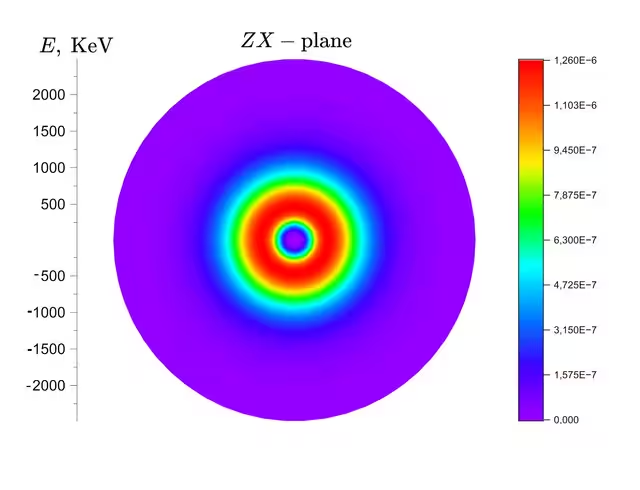
FIG1:Pseudo-color plot of differential probabilities,
corresponding to projections of the emitted positron momentum
kz and kx in the collision plane. Asymmetric collision with U$^{92+}$- Cm$^{96+}$,
Rmin = 17.5 fm and collision energy ε = 1.0. The color scale is linear.
This work was financially supported by the Russian Science Foundation (grant No. 22-62-00004).
References
1 N. K. Dulaev, D. A. Telnov, V. M. Shabaev, Y. S. Kozhedub, X. Ma, I. A. Maltsev, R. V.
Popov, I. I. Tupitsyn. Three-dimensional calculations of positron creation in supercritical
collisions of heavy nuclei. Physical Review D, 111, 016018 (2025).