SCIENCE BRINGS NATIONS TOGETHER
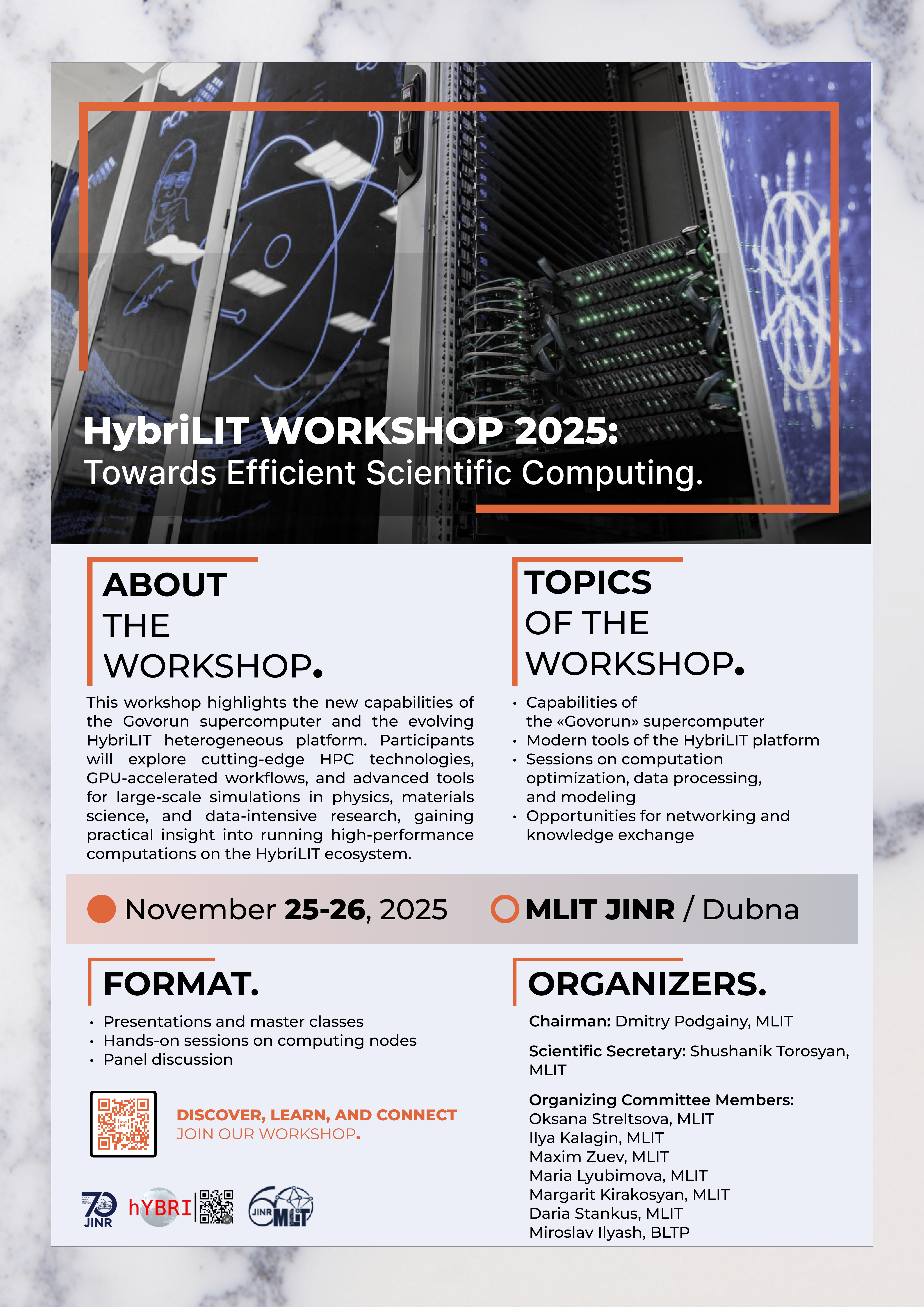
HybriLIT WORKSHOP 2025: Towards Efficient Scientific Computing

Europe/Moscow
MLIT-134/5-* - Conference Hall (MLIT)

MLIT-134/5-* - Conference Hall

MLIT

Дмитрий Подгайный (JINR)
Description

HYBRILIT WORKSHOP 2025 highlights the capabilities of the Govorun supercomputer and the evolving HybriLIT heterogeneous platform.
Participants will explore cutting-edge HPC technologies, GPU-accelerated workflows, and advanced tools for large-scale simulations in physics, biology, and data-intensive research, gaining practical insight into running high-performance computations on the HybriLIT ecosystem.

The workshop is organized by the HybriLIT heterogeneous computing team and is dedicated to the anniversary of JINR.

Chairman:
Dmitry Podgainy, MLIT

Scientific Secretary:
Shushanik Torosyan, MLIT

Organizing Committee Members:
Oksana Streltsova, MLIT
Ilya Kalagin, MLIT
Maxim Zuev, MLIT
Maria Lyubimova, MLIT
Margarit Kirakosyan, MLIT
Stankus Daria, MLIT
Miroslav Iliaš, BLTP

Contacts:
Address:    MLIT Conference Hall
E-mail:       shushanik@jinr.ru
URL:
          https://jinr.mts-link.ru/j/28441625/7759730685

Important:
Participants are required to bring their personal laptops for the hands-on sessions.

Scientific secretary
Participants
  • Tuesday 25 November
    • 14:00 14:05
      Welcome Address by the Director of MLIT 5m
      Speaker: Sergei Shmatov (JINR)
    • 14:05 14:10
      Welcome Address by the Deputy Director of MLIT 5m
      Speaker: Дмитрий Подгайный (JINR)
    • 14:10 14:30
      The Govorun supercomputer for JINR tasks 20m

      The heterogeneous computing platform HybriLIT is a multi-component system consisting of the “Govorun” supercomputer, a training and testing polygon, networked data storage systems, and a set of specialized services. The platform is designed for application development, high-performance computing, data processing, and data storage.
      The presentation will provide an overview of the software and information environment of the HybriLIT Heterogeneous Computing Platform and the specialized services used to address JINR’s scientific and applied tasks.

      Speaker: Mr Максим Зуев (MLIT JINR)
    • 14:30 14:50
      Working on the HybriLIT heterogeneous platform 20m

      TBD

      Speaker: Дмитрий Беляков (MLIT JINR)
    • 14:50 15:10
      ML/DL/HPC ecosystem for solving applied tasks 20m

      The presentation will showcase the capabilities of the ecosystem deployed on the HybriLIT platform for developing algorithms based on machine learning and deep learning methods, data annotation, service deployment, and more.

      Speaker: Оксана Стрельцова (JINR)
    • 15:10 15:30
      HLIT-VDI for working with proprietary software 20m

      TBD

      Speaker: Mikhail Matveyev (JINR)
    • 15:30 15:50
      How to become a user of the HybriLIT Heterogeneous Platform 20m

      The HybriLIT platform is part of the Multifunctional Information and Computing Complex of the JINR Laboratory of Information Technologies. It includes the “Govorun” supercomputer and a training and testing cluster designed for developing and running high-performance parallel applications.
      The presentation provides a step-by-step guide on how to gain access to HybriLIT resources, including registration, initial authorization, SSH connection procedures for Linux and Windows users, as well as specifics of working with graphical applications. Participants will also learn how to request access to the “Govorun” supercomputer and what services are available within the HybriLIT ecosystem.

      Speakers: Shushanik Torosyan (LIT), Маргарит Киракосян (LIT), Мария Любимова
    • 15:50 16:10
      Coffee Break 20m
    • 16:10 16:30
      Comparative DFT Study of Adsorption of Superheavy Elements Cn and Fl, and Their Lighter Homologs Hg and Pb on Selenium Surface 20m

      In this computational study, we investigate the adsorption of superheavy
      elements Copernicium (Cn) and Flerovium (Fl), and their lighter homologs
      Mercury (Hg) and Lead (Pb), on a Selenium (100) surface. Our approach
      employs periodic Density Functional Theory (DFT) in Quantum ESPRESSO
      (open-source suite of codes)with spin-orbit coupling and DFT-D4
      dispersion correction. Our resultsshow that while a standard Perdew-Burke Ernzerhof (PBE) setup (functional and pseudopotential) captures the correct adsorption trend, a hybrid approach using the Perdew-Burke-
      Ernzerhof for solids (PBEsol) functional with PBEsol pseudopotentials
      for Se and PBE pseudopotentials for the adsorbates provides superior
      accuracy for adsorption energy values. We further probed the adsorbate-
      surface interactions and stability through density of states, charge
      transfer, and vibrational analysis.

      Speaker: Dipayan Sen (Bogoliubov Laboratory of Theoretical Physics, Joint Institute for Nuclear Research)
    • 16:30 16:50
      Computational Molecular Physics at Work 20m

      I'll give a brief overview of computational molecular physics (CMP)
      techniques in my talk. They fall into two groups: Molecular Mechanics
      (MM) and Quantum Mechanics (QM). MM approaches use predefined
      analytical interatomic potentials, whereas QM approaches rely on an
      approximate solution of the many-electron Schrödinger equation.
      Likewise I'll describe few open-source CMP applications that Govorun
      users can utilize for their scientific work at JINR.

      Speaker: Dr Мирослав Ильяш (BLTP JINR)
    • 16:50 17:20
      TUTORIAL: Computational Molecular Physics 30m

      Computational Molecular Physics hands-on-execercises are available at: HybriLIT-workshop-2025-materials

      Speaker: Dr Мирослав Ильяш (BLTP JINR)
  • Wednesday 26 November
    • 14:00 14:20
      Training neural networks in PyTorch on HybriLIT GPUs 20m

      The presentation demonstrates how the GPU resources of the HybriLIT platform at the JINR Laboratory of Information Technologies are used for deep learning models. It covers the organization of a virtual working environment and the installation of PyTorch with CUDA support. As an example, results are shown for computations using the State-Space Model (Mamba) architecture applied to tabular data.

      Speaker: Константин Чижов (MLIT)
    • 14:20 14:40
      Monte Carlo simulation in Geant4 for complex models on the Govorun supercomputer 20m

      Monte Carlo simulation in Geant4 is a highly resource-intensive process. The presentation introduces the experience of computing a complex model using the resources of the “Govorun” supercomputer and discusses aspects of running jobs through the SLURM scheduler as well as error handling.

      Speaker: Константин Чижов (MLIT)
    • 14:40 15:00
      Automated quantification of DNA repair foci in response to ionizing radiation 20m

      Ionizing radiation induces a variety of DNA lesions, including DNA double-strand breaks (DSBs), which are among the most challenging to repair. The formation of these lesions initiates a cascade of DNA repair protein recruitment, leading to the formation of radiation-induced foci (RIF). To automate the RIF analysis, we have followed a deep learning approach which consists of two stages; first a pretrained neural network called SAM2 is used to detect the cell nuclei in the fluorescent image, then the trained neural network YOLO on our foci-annotated data is used to detect RIF within each nucleus. Following RIF detection and individual image preprocessing on each focus location, the colocalized number of the two foci are calculated. Based on this model, we developed a web service on WRITER Framework for the automated RIF detection and quantification of object-based colocalization between two RIF populations. The web service MOSTLIT allows the user to observe the identified cell nuclei in an uploaded fluorescent image, choose the desired nuclei, automatically get the marked foci and obtain the numerical characteristics such as the number of RIF per cell, RIF area and colocalizations.

      Speaker: Sara Shadmehri
    • 15:00 15:20
      A platform for working with medical data 20m

      TBD

      Speaker: Anastasia Anikina (MLIT, JINR)
    • 15:20 15:40
      Approaches to accelerating computations in Python 20m

      The presentation will cover the main approaches to accelerating computations in Python. Special attention is given to the NumPy library, which provides efficient array operations and significantly improves performance. The use of the Numba JIT compiler is also discussed, enabling faster function execution by compiling them into machine code. To increase performance on multicore systems, CPU parallelism is introduced through the Joblib library, which simplifies task parallelization. In addition, the presentation explores the use of GPUs for computation with CuPy and Numba CUDA, allowing substantial reductions in processing time for large datasets. The Jupyter Book tool is also presented as a way to create interactive electronic books based on Jupyter Notebook, combining text, code, visualizations, and computations into a user-friendly format.

      Speaker: Mrs Adiba Rahmonova (Joint Institute for Nuclear Research)
    • 15:40 16:00
      Capabilities of the Hybrilit Platform for Simulating Quantum-Classical Optimization Algorithms 20m

      Quantum Approximate Optimization Algorithm (QAOA) simulations were performed on the Hybrilit quantum testbed at JINR. The testbed infrastructure is well suited for such research: significant computational resources are available, including multi-core CPUs, GPUs, and RAM; JupyterHub, as well as quantum simulators Cirq, Qiskit, qsim, and other are deployed. The problem of finding the ground state of the Ising model with a longitudinal magnetic field was solved for two- and three-dimensional lattices of various sizes. Quantum circuits with registers of up to 27 qubits were investigated. Optimization of variational ansatz parameters was carried out using both gradient-based and gradient-free methods. The processes and results of optimization performed by different methods were compared across several parameters. The dependence of computational efficiency on the configuration of used computational resources was demonstrated.

      Speakers: Denis Yanovich (senior researcher), Dr Yuri Palii (MLIT, JINR), Алла Боголюбская (JINR, Dubna)
    • 16:00 16:15
      Q&A session 15m
    • 16:15 16:35
      Coffee Break 20m
    • 16:35 17:35
      TUTORIAL: ML/DL/HPC ecosystem for solving applied tasks 1h

      The presentation will showcase the capabilities of the ecosystem deployed on the HybriLIT platform for developing algorithms based on machine learning and deep learning methods, data annotation, service deployment, and more.

      The work was performed with the support of the Russian Science Foundation within the framework of project No. 22-71-10022

      Совместный редактор кода hedgedoc.jinr.ru

      Speakers: Mrs Adiba Rahmonova (Joint Institute for Nuclear Research), Sara Shadmehri, Дмитрий Подгайный (JINR), Илхом Рахмонов (BLTP, Joint Institute for Nuclear Research), Mr Максим Зуев (MLIT JINR), Оксана Стрельцова (JINR)
    • 17:35 18:35
      TUTORIAL: Scientific computing and the development of parallel algorithms using the Julia programming language 1h

      This master class demonstrates the potential of the Julia programming language for exploring multiparameter models described by systems of nonlinear differential equations. A model of a point φ0 Josephson junction of the superconductor-ferromagnet-superconductor type with a direct relationship between the magnetic moment and the Josephson current is considered as an example. A methodology for preparing a problem for calculations, the specifics of numerically solving systems of equations, and the capabilities of the Julia language for implementing parallel computations for calculating magnetic moment flip domains over a wide range of parameters are presented.

      Speakers: Maksim Bashashin (Laboratory of Information Technologies, JINR), Mikhail Matveyev (JINR)